Kenya’s 8 Million Tonnes of Annual Waste Could Unlock USD 730 Million in Investment
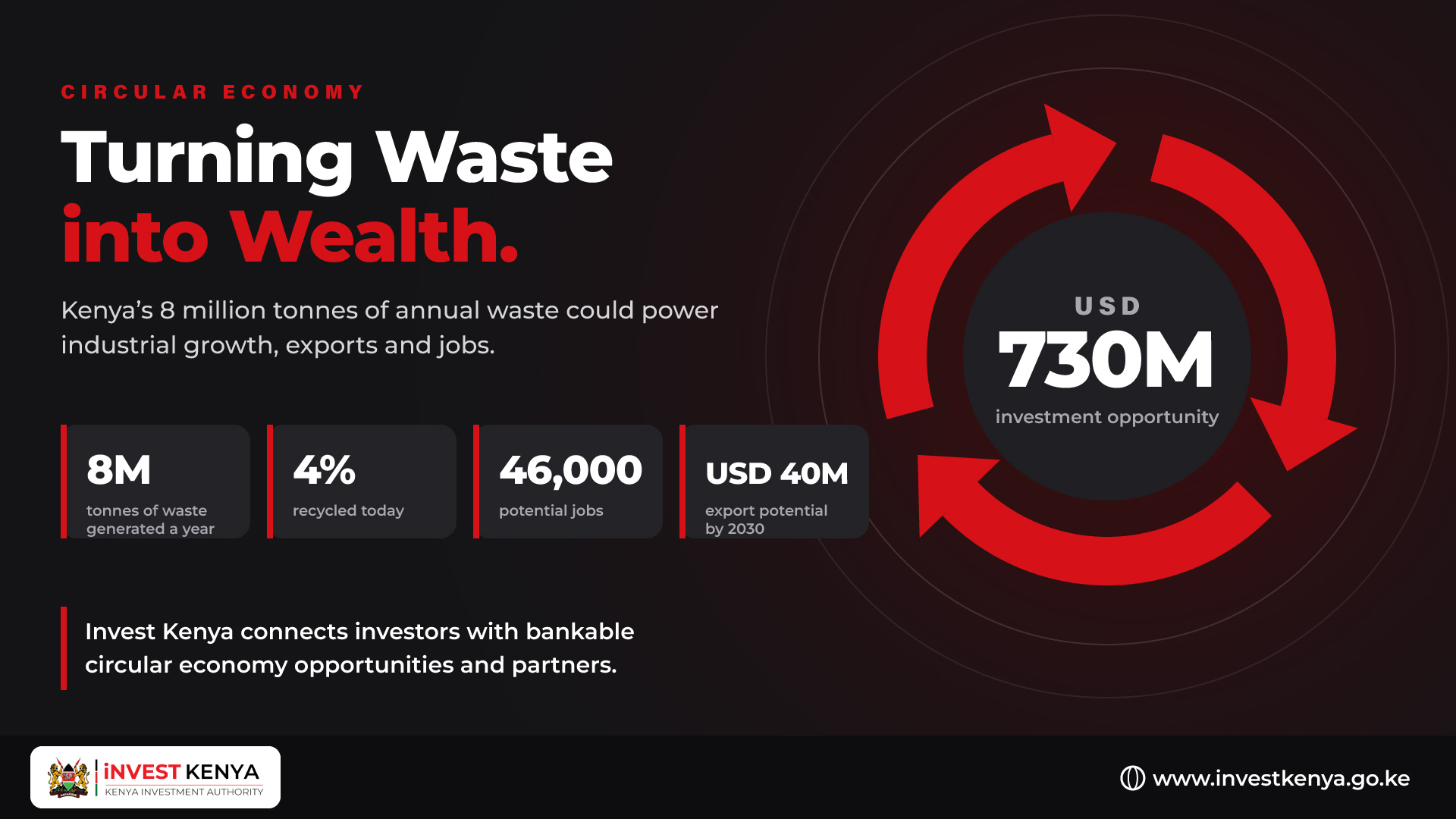
An estimated 8 million tonnes of waste generated annually in Kenya could become a source of industrial growth, exports and employment, with the circular economy presenting a USD 730 million investment opportunity.
The figures formed part of Invest Kenya CEO John Mwendwa’s keynote address at the 4th Kenya Extended Producer Responsibility Organization (KEPRO) Annual Circular Packaging Conference (KACPC IV), where government, manufacturers, investors and development partners examined opportunities to scale sustainable packaging and resource recovery.
Kenya generates approximately 22,000 tonnes of waste every day, but recycles only 4 per cent. The gap presents a commercial opportunity to invest in collection systems, sorting facilities, recycling technologies and manufacturing processes that convert discarded materials into valuable industrial inputs.
The potential economic returns extend beyond waste management. According to figures highlighted during the conference, circular economy activities could contribute 0.5 per cent to GDP, unlock USD 335 million through local sourcing of secondary materials, increase exports by a potential USD 40 million by 2030 and create approximately 46,000 jobs. More than 120 circularity-focused businesses already operate in the country, providing a foundation for further investment and industry expansion.
For manufacturers, recovering and reusing materials can reduce dependence on virgin and imported raw materials while creating more resilient domestic supply chains. For investors, opportunities span plastics and packaging recycling, material recovery, waste processing, alternative packaging, recycling equipment and the production of goods using recovered materials.
Extended Producer Responsibility (EPR) is also reshaping the commercial landscape by increasing the focus on how products and packaging are collected, recovered and managed after use. This creates demand for businesses capable of delivering compliant, efficient and scalable recovery solutions, alongside opportunities for partnerships between producers, recyclers and technology providers.
However, converting the opportunity into viable businesses will require investment in modern infrastructure, reliable waste collection, technology, financing and stronger connections between waste recovery and manufacturing. Consistent implementation of environmental regulations and greater participation by counties, producers and private investors will be essential to building commercially sustainable circular value chains.
The conference brought together key stakeholders, including Special Guest Eng. Dr. Festus Ng’eno, Principal Secretary for Environment and Climate Change; Steve Muli, Chair of KEPRO Kenya; and Tobias Alando, Chief Executive Officer of the Kenya Association of Manufacturers. Their participation reflected the importance of coordination between government and industry in advancing sustainable packaging, resource efficiency and green industrialisation.
For Kenya, the investment case is clear: waste can become a productive resource for manufacturing, enterprise development and export growth. Developing circular value chains would also position local businesses to serve regional markets as demand grows for sustainable materials and packaging solutions.
Invest Kenya is focused on connecting investors with bankable opportunities, strategic partners and the support needed to establish and scale circular economy businesses in the country.
With 8 million tonnes of waste generated annually, a recycling rate of just 4 per cent and an estimated USD 730 million investment opportunity, Kenya has significant scope to turn an environmental challenge into a new engine of industrial growth, private sector investment and job creation.